Patella
You don't need to be Editor-In-Chief to add or edit content to WikiDoc. You can begin to add to or edit text on this WikiDoc page by clicking on the edit button at the top of this page. Next enter or edit the information that you would like to appear here. Once you are done editing, scroll down and click the Save page button at the bottom of the page.
| Bone: Patella | |
|---|---|
| Knee diagram | |
| Gray's | subject #60 255 |
| MeSH | Patella |
|
WikiDoc Resources for Patella | |
|
Articles | |
|---|---|
|
Most recent articles on Patella | |
|
Media | |
|
Evidence Based Medicine | |
|
Clinical Trials | |
|
Ongoing Trials on Patella at Clinical Trials.gov Clinical Trials on Patella at Google
| |
|
Guidelines / Policies / Govt | |
|
US National Guidelines Clearinghouse on Patella
| |
|
Books | |
|
News | |
|
Commentary | |
|
Definitions | |
|
Patient Resources / Community | |
|
Directions to Hospitals Treating Patella Risk calculators and risk factors for Patella
| |
|
Healthcare Provider Resources | |
|
Causes & Risk Factors for Patella | |
|
Continuing Medical Education (CME) | |
|
International | |
|
| |
|
Business | |
|
Experimental / Informatics | |
Please Take Over This Page and Apply to be Editor-In-Chief for this topic: There can be one or more than one Editor-In-Chief. You may also apply to be an Associate Editor-In-Chief of one of the subtopics below. Please mail us [1] to indicate your interest in serving either as an Editor-In-Chief of the entire topic or as an Associate Editor-In-Chief for a subtopic. Please be sure to attach your CV and or biographical sketch.
Overview
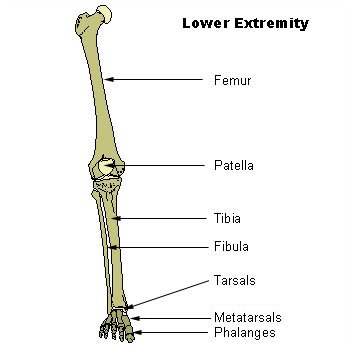
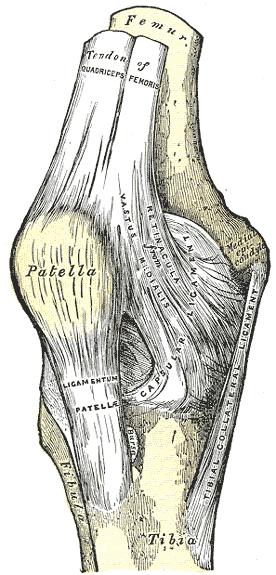
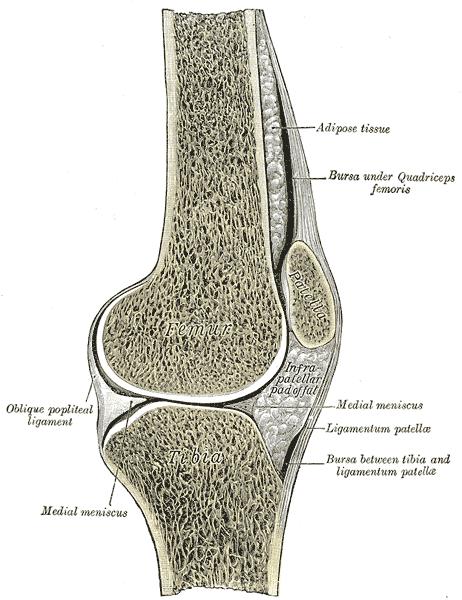
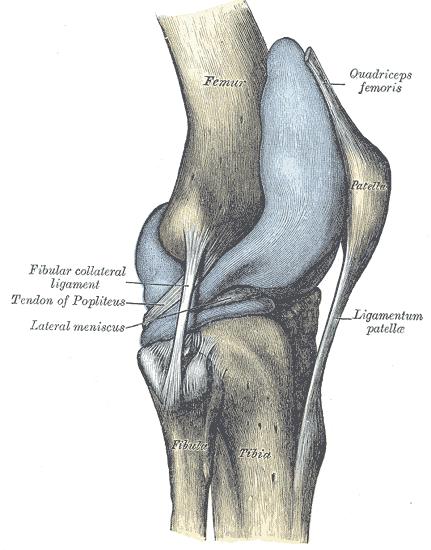
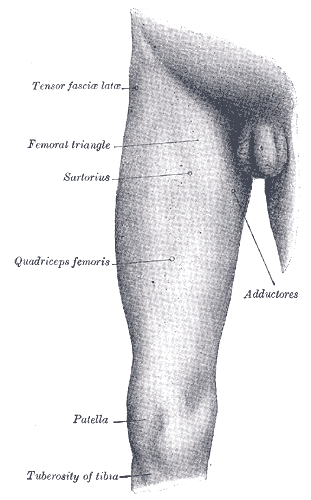
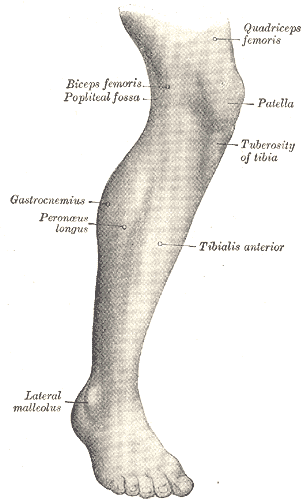
The patella or kneecap is a thick, triangular bone which articulates with the femur and covers and protects the front of the knee joint. It is the largest sesamoid bone in the human body. It is attached to the tendon of the quadriceps femoris muscle, which contracts to straighten the leg. The vastus intermedialis muscle is attached to the base of patella. The vastus lateralis and vastus medialis are attached to lateral and medial borders of patella respectively.
The patella is stabilised by the insertion of vastus medialis and the prominence of the anterior femoral condyles, which prevent lateral dislocation during flexion. The retinacular fibres of the patella also stabilise it during exercise.
The primary functional role of the patella is knee extension. The patella increases the leverage that the tendon can exert on the femur by increasing the angle at which it acts.
The patella ossifies between the ages 2-6 years. In some people it may be absent congenitally or hypoplastic. In 2% of the population there is a bipartite patella, which is usually asymptomatic.
Regarding non-human animals, the patella is fully developed only in placental mammals; marsupials have only rudimentary, non-ossified patellae.[1]
See also
Additional images
References
- ↑ Herzmark MH (1938). "The Evolution of the Knee Joint". J Bone Joint Surg Am 20: 77-84. Retrieved on 2007-11-17.
External links
WikiDoc Research Resources for Patella | |
|---|---|
| Articles on Patella | Most recent articles on Patella • Most cited articles on Patella • Review articles on Patella • Articles on Patella in N Eng J Med, Lancet, BMJ |
| Media (Slides, Video, Images, MP3) on Patella | Powerpoint slides on Patella • Images of Patella • Photos of Patella • Podcasts & MP3s on Patella • Videos on Patella |
| Evidence Based Medicine Regarding Patella | Cochrane Collaboration on Patella • Bandolier on Patella • TRIP on Patella |
| Cost Effectiveness of Patella | Cost Effectiveness of Patella |
| Clinical Trials Involving Patella | Ongoing Trials on Patella at Clinical Trials.gov • Trial results on Patella • Clinical Trials on Patella at Google |
| Guidelines / Policies / Government Resources (FDA/CDC) Regarding Patella | US National Guidelines Clearinghouse on Patella • NICE Guidance on Patella • NHS PRODIGY Guidance • FDA on Patella • CDC on Patella |
| Textbook Information on Patella | Books and Textbook Information on Patella |
| Pharmacology Resources on Patella | Dosing of Patella • Drug interactions with Patella • Side effects of Patella • Allergic reactions to Patella • Overdose information on Patella • Carcinogenicity information on Patella • Patella in pregnancy • Pharmacokinetics of Patella • |
| Genetics, Pharmacogenomics, and Proteinomics of Patella | Genetics of Patella • Pharmacogenomics of Patella • Proteomics of Patella |
| Newstories on Patella | Patella in the news • Be alerted to news on Patella • News trends on Patella |
| Commentary on Patella | Blogs on Patella |
| Patient Resources on Patella | Patient resources on Patella • Discussion groups on Patella • Patient Handouts on Patella • Directions to Hospitals Treating Patella • Risk calculators and risk factors for Patella |
| Healthcare Provider Resources on Patella | Symptoms of Patella • Causes & Risk Factors for Patella • Diagnostic studies for Patella • Treatment of Patella |
| Continuing Medical Education (CME) Programs on Patella | CME Programs on Patella |
| International Resources on Patella | Patella en Espanol • Patella en Francais |
| Business Resources on Patella | Patella in the Marketplace • Patents on Patella |
| Informatics Resources on Patella | List of terms related to Patella |
| ||||
Acknowledgement and Attribution Regarding Sources of Content
Some of the initial content on this page may be incorporated in part from copyleft sources in the public domain including wikis such as Wikipedia and AskDrWiki. Drug information for patients came from the The National Library of Medicine. Infectious disease information may have come from the Centers for Disease Control (CDC). Differential Diagnoses are drawn from clinicians as well as an amalgamation of 3 sources: 1.The Disease Database; 2. Kahan, Scott, Smith, Ellen G. In A Page: Signs and Symptoms. Malden, Massachusetts: Blackwell Publishing, 2004:3; 3. Sailer, Christian, Wasner, Susanne. Differential Diagnosis Pocket. Hermosa Beach, CA: Borm Bruckmeir Publishing LLC, 2002:7 .