Vestibulocochlear nerve

You don't need to be Editor-In-Chief to add or edit content to WikiDoc. You can begin to add to or edit text on this WikiDoc page by clicking on the edit button at the top of this page. Next enter or edit the information that you would like to appear here. Once you are done editing, scroll down and click the Save page button at the bottom of the page.

Jump to: navigation, search
Nerve: Vestibulocochlear nerve
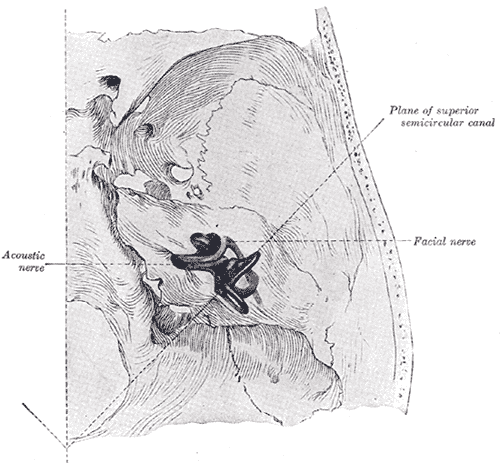
The course and connections of the facial nerve in the temporal bone
Gray's subject #203
To cochlear nerve, vestibular nerve
MeSH Vestibulocochlear+Nerve

Editor-In-Chief: C. Michael Gibson, M.S., M.D. [1] Phone:617-632-7753

WikiDoc Resources for

Vestibulocochlear nerve

Articles

Most recent articles on Vestibulocochlear nerve

Most cited articles on Vestibulocochlear nerve

Review articles on Vestibulocochlear nerve

Articles on Vestibulocochlear nerve in N Eng J Med, Lancet, BMJ

Media

Powerpoint slides on Vestibulocochlear nerve

Images of Vestibulocochlear nerve

Photos of Vestibulocochlear nerve

Podcasts & MP3s on Vestibulocochlear nerve

Videos on Vestibulocochlear nerve

Evidence Based Medicine

Cochrane Collaboration on Vestibulocochlear nerve

Bandolier on Vestibulocochlear nerve

TRIP on Vestibulocochlear nerve

Clinical Trials

Ongoing Trials on Vestibulocochlear nerve at Clinical Trials.gov

Trial results on Vestibulocochlear nerve

Clinical Trials on Vestibulocochlear nerve at Google

Guidelines / Policies / Govt

US National Guidelines Clearinghouse on Vestibulocochlear nerve

NICE Guidance on Vestibulocochlear nerve

NHS PRODIGY Guidance

FDA on Vestibulocochlear nerve

CDC on Vestibulocochlear nerve

Books

Books on Vestibulocochlear nerve

News

Vestibulocochlear nerve in the news

Be alerted to news on Vestibulocochlear nerve

News trends on Vestibulocochlear nerve

Commentary

Blogs on Vestibulocochlear nerve

Definitions

Definitions of Vestibulocochlear nerve

Patient Resources / Community

Patient resources on Vestibulocochlear nerve

Discussion groups on Vestibulocochlear nerve

Patient Handouts on Vestibulocochlear nerve

Directions to Hospitals Treating Vestibulocochlear nerve

Risk calculators and risk factors for Vestibulocochlear nerve

Healthcare Provider Resources

Symptoms of Vestibulocochlear nerve

Causes & Risk Factors for Vestibulocochlear nerve

Diagnostic studies for Vestibulocochlear nerve

Treatment of Vestibulocochlear nerve

Continuing Medical Education (CME)

CME Programs on Vestibulocochlear nerve

International

Vestibulocochlear nerve en Espanol

Vestibulocochlear nerve en Francais

Business

Vestibulocochlear nerve in the Marketplace

Patents on Vestibulocochlear nerve

Experimental / Informatics

List of terms related to Vestibulocochlear nerve

Please Take Over This Page and Apply to be Editor-In-Chief for this topic: There can be one or more than one Editor-In-Chief. You may also apply to be an Associate Editor-In-Chief of one of the subtopics below. Please mail us [2] to indicate your interest in serving either as an Editor-In-Chief of the entire topic or as an Associate Editor-In-Chief for a subtopic. Please be sure to attach your CV and or biographical sketch.

Overview

The vestibulocochlear nerve (also known as the auditory or acoustic nerve) is the eighth of twelve cranial nerves, and is responsible for transmitting sound and equilibrium (balance) information from the inner ear to the brain.

Structure

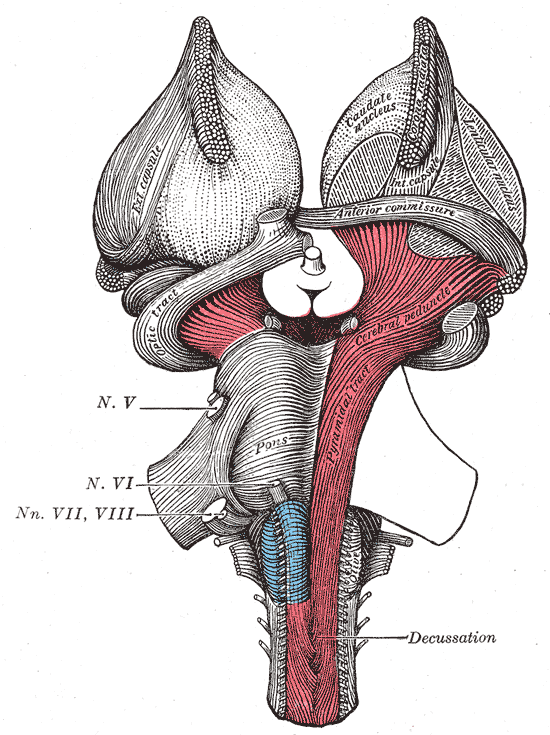
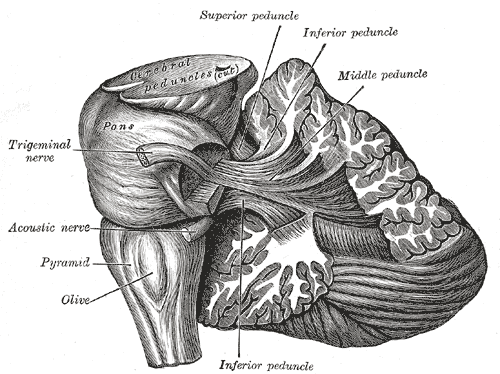
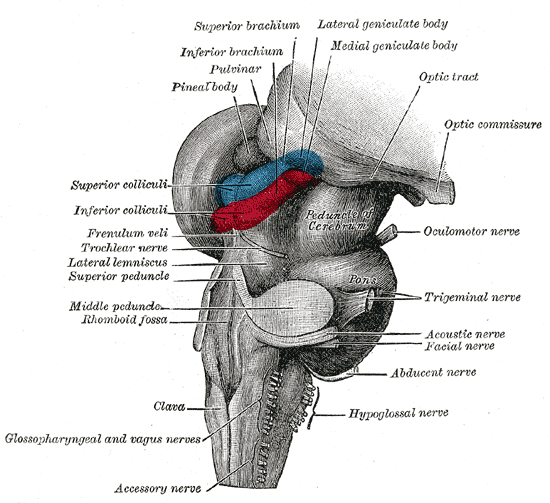
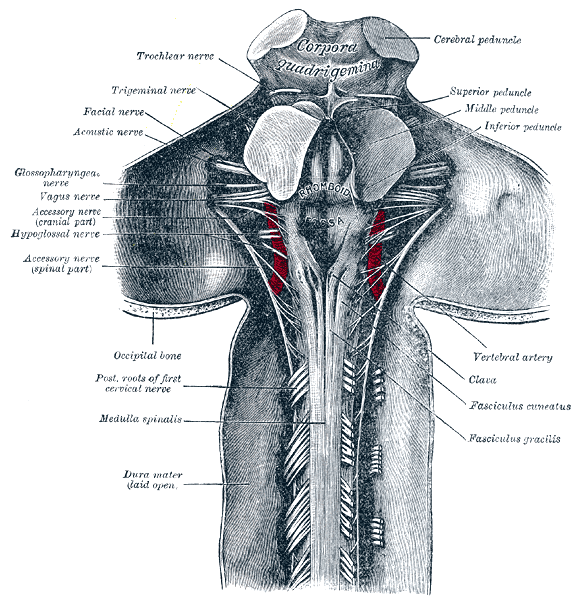
This nerve, along which the sensory cells (the hair cells) of the inner ear transmit information to the brain. It consists of the cochlear nerve, carrying information about hearing, and the vestibular nerve, carrying information about balance. It emerges from the medulla oblongata and enters the inner skull via the internal acoustic meatus (or internal auditory meatus) in the temporal bone, along with the facial nerve.

Functions

The eighth cranial nerve has two prime roles. It is needed to convey information of vestibular sensation - that is, the position and movement of the head. Secondly, it is used for hearing.

Innervations

The nerve splits into two large divisions - the cochlear nerve and the vestibular nerve. Broadly speaking, the cochlear nerve innervates the cochlea, while the vestibular nerve goes to the vestibular apparatus.

Physiology

How hearing information is coded on the nerve has long been a matter of scientific debate between two competing theories, a place theory and a rate theory.

Symptoms of damage

vertigo, false sense of motion, loss of equilibrium (dark places), nystagmus, motion sickness

Name

Some older texts call the nerve the acoustic or auditory nerve [3], but these terms have fallen out of widespread use because they fail to recognize the nerve's role in the vestibular system. Vestibulocochlear nerve is therefore preferred by most.

Additional images

External links

de:Nervus vestibulocochlearisit:Nervo vestibolococleare

lt:Prieangio ir sraigės nervas nl:Nervus vestibulocochlearisno:Nervus vestibulocochlearisfi:Kuulo-tasapainohermo


WikiDoc Help Menu

Quick Start..

Editing basics

Advanced editing

Communicating your edits

Help Videos You Can Watch

Acknowledgement and Attribution Regarding Sources of Content

Some of the initial content on this page may be incorporated in part from copyleft sources in the public domain including wikis such as Wikipedia and AskDrWiki. Drug information for patients came from the The National Library of Medicine. Infectious disease information may have come from the Centers for Disease Control (CDC). Differential Diagnoses are drawn from clinicians as well as an amalgamation of 3 sources: 1.The Disease Database; 2. Kahan, Scott, Smith, Ellen G. In A Page: Signs and Symptoms. Malden, Massachusetts: Blackwell Publishing, 2004:3; 3. Sailer, Christian, Wasner, Susanne. Differential Diagnosis Pocket. Hermosa Beach, CA: Borm Bruckmeir Publishing LLC, 2002:7 .