Urethra
|
WikiDoc Resources for Urethra |
|
Articles |
|---|
|
Most recent articles on Urethra |
|
Media |
|
Evidence Based Medicine |
|
Clinical Trials |
|
Ongoing Trials on Urethra at Clinical Trials.gov Clinical Trials on Urethra at Google
|
|
Guidelines / Policies / Govt |
|
US National Guidelines Clearinghouse on Urethra
|
|
Books |
|
News |
|
Commentary |
|
Definitions |
|
Patient Resources / Community |
|
Directions to Hospitals Treating Urethra Risk calculators and risk factors for Urethra
|
|
Healthcare Provider Resources |
|
Causes & Risk Factors for Urethra |
|
Continuing Medical Education (CME) |
|
International |
|
|
|
Business |
|
Experimental / Informatics |
Editor-In-Chief: C. Michael Gibson, M.S., M.D. [1]
In anatomy, the urethra is a tube which connects the urinary bladder to the outside of the body. The urethra has an excretory function in both genders to pass urine to the outside, and also a reproductive function in the male, as a passage for sperm.
The external urethral sphincter is a striated muscle that allows voluntary control over urination.
Anatomy
Female urethra

In the human female, the urethra is about 1-2 inches long and opens in the vulva between the clitoris and the vaginal opening.
Because of the short length of the urethra, women tend to be more susceptible to infections of the bladder (cystitis) and the urinary tract.
Male urethra

In the human male, the urethra is about 8 inches (20 cm) long and opens at the end of the penis. The inside of the urethra has a spiral groove (like rifling in a gun barrel), which makes the urine flow in a wide stream.
The urethra is divided into three parts in men, named after the location:
| Region | Description | Epithelium |
| prostatic urethra | Crosses through the prostate gland. There are several openings: (1) a small opening where sperm from the vas deferens and ejaculatory duct enters, (2) the prostatic ducts where fluid from the prostate enters, (3) an opening for the prostatic utricle, but nothing is added from it. These openings are collectively called the verumontanum. | Transitional |
| membranous urethra | A small (1 or 2 cm) portion passing through the external urethral sphincter. This is the narrowest part of the urethra. It is located in the deep perineal pouch. The ducts from the bulbourethral glands enter here. | Pseudostratified columnar |
| spongy urethra (or penile urethra) | Runs along the length of the penis on its ventral (underneath) surface. It is about 15-16 cm in length, and travels through the corpus spongiosum. The ducts from the urethral gland enter here. | Pseudostratified columnar |
The length of a male's urethra, and the fact it contains a number of bends, makes catheterisation more difficult.
Histology
The epithelium of the urethra starts off as transitional cells as it exits the bladder. Further along the urethra there are stratified columnar cells, then stratified squamous cells near the external meatus (exit hole).
There are small mucus-secreting urethral glands, that help protect the epithelium from the corrosive urine.
Medical problems of the urethra
- Hypospadias and epispadias are forms of abnormal development of the urethra in the male, where the opening is not quite where it should be (it occurs lower than normal with hypospadias, and higher with epispadias). In a severe chordee, the urethra can develop between the penis and the scrotum.
- Infection of the urethra is urethritis, said to be more common in females than males. Urethritis is a common cause of dysuria (pain when urinating).
- Related to urethritis is so called urethral syndrome
- Passage of kidney stones through the urethra can be painful and subsequently it can lead to urethral strictures.
Endoscopy of the bladder via the urethra is called cystoscopy.
Sexual physiology
The male urethra is the conduit for sperm during sexual intercourse. It also serves as a passage for urine to flow.
See also
- Perineal urethra
- Vulvovaginal health
- Urethral sponge
- G-spot
- Urethral sounding
- Urethrotomy
- External urethral orifice
- Internal urethral orifice
Additional images
-
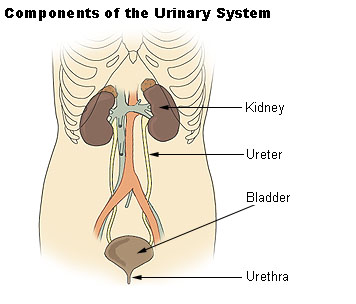
Urinary system
-
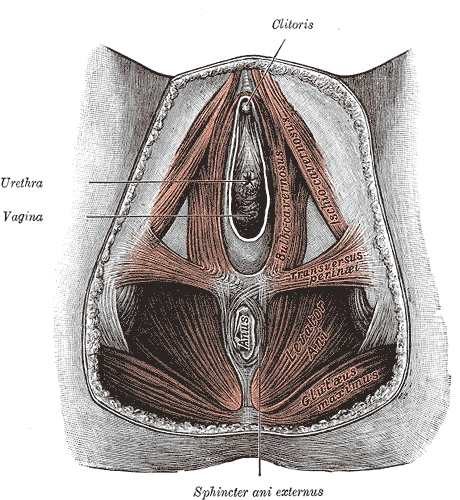
Muscles of the female perineum.
-
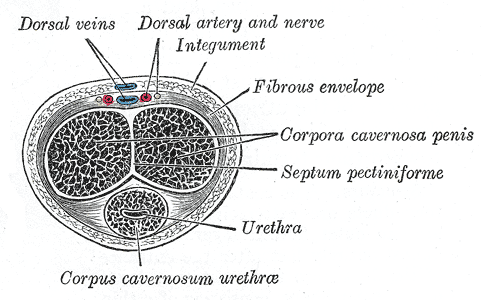
Transverse section of the penis.


![[2]](http://www.brooksidepress.org/Products/Urethra.jpg)
External links
- Histology at KUMC epithel-epith07 "Male Urethra"
Template:Urinary system Template:Male reproductive system
ar:إحليل bg:Пикочен канал cs:Močová trubice de:Harnröhre id:Uretra it:Uretra he:שופכה ku:Pêşborî lt:Šlaplė nl:Urinebuis no:Urinrør simple:Urethra sk:Močová rúra su:Urétra fi:Virtsaputki sv:Urinrör