Lesser sac
The lesser sac, also known as the omental bursa, is the cavity in the abdomen that is formed by the lesser and greater omentum. Usually found in mammals, it is connected with the greater sac via the epiploic foramen (also known as the Foramen of Winslow). In mammals, it is not uncommon for the lesser sac to contain considerable amounts of fat.
In human anatomy, the wall of the stomach, pancreas and splenic artery[1] are a part of the wall of the lesser sac. If these structures rupture they may leak into the lesser sac. For the stomach, which lies anterior to the omental bursa, the rupture must be on the posterior side, as if it were anteriorly located, the leak would collect in the greater sac.
The lesser sac is embryologically formed from an infolding of the greater omentum. The open end of the infolding, known as the epiploic foramen, is usually proximal to the stomach.
Additional images
-
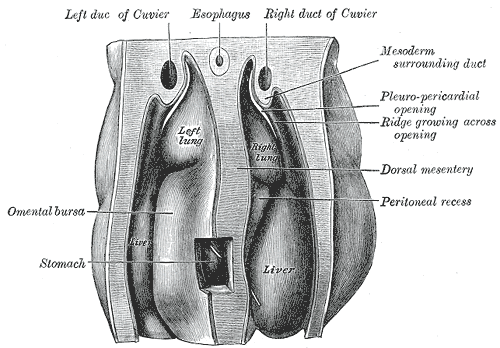 Upper part of celom of human embryo of 6.8 mm., seen from behind.
 -
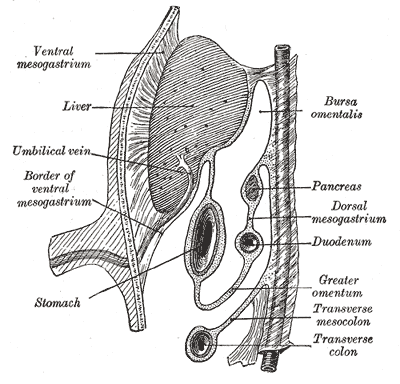 Schematic figure of the bursa omentalis, etc. Human embryo of eight weeks.
 -
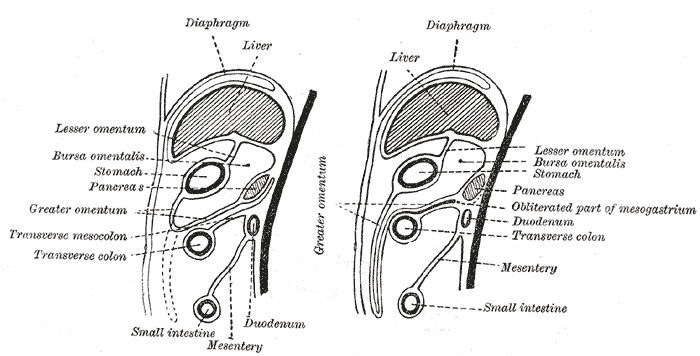 Diagrams to illustrate the development of the greater omentum and transverse mesocolon.


See also
References
External links
- Template:Medcyclopaedia
- Template:SUNYAnatomyLabs - "Abdominal Cavity: The Lesser Peritoneal Sac"
- Template:SUNYAnatomyImage