Courvoisier's law
| Courvoisier's law | |
 | |
|---|---|
| Palpable Gall Bladder Image courtesy of Charlie Goldberg, M.D., UCSD School of Medicine and VA Medical Center, San Diego, California |
|
WikiDoc Resources for Courvoisier's law |
|
Articles |
|---|
|
Most recent articles on Courvoisier's law Most cited articles on Courvoisier's law |
|
Media |
|
Powerpoint slides on Courvoisier's law |
|
Evidence Based Medicine |
|
Cochrane Collaboration on Courvoisier's law |
|
Clinical Trials |
|
Ongoing Trials on Courvoisier's law at Clinical Trials.gov Trial results on Courvoisier's law Clinical Trials on Courvoisier's law at Google
|
|
Guidelines / Policies / Govt |
|
US National Guidelines Clearinghouse on Courvoisier's law NICE Guidance on Courvoisier's law
|
|
Books |
|
News |
|
Commentary |
|
Definitions |
|
Patient Resources / Community |
|
Patient resources on Courvoisier's law Discussion groups on Courvoisier's law Patient Handouts on Courvoisier's law Directions to Hospitals Treating Courvoisier's law Risk calculators and risk factors for Courvoisier's law
|
|
Healthcare Provider Resources |
|
Causes & Risk Factors for Courvoisier's law |
|
Continuing Medical Education (CME) |
|
International |
|
|
|
Business |
|
Experimental / Informatics |
Editor-In-Chief: C. Michael Gibson, M.S., M.D. [1]
Courvoisier's law (or Courvoisier syndrome, or Courvoisier's sign) states that in the presence of a palpable gall bladder, jaundice is unlikely to be caused by gallstones. This is because gallstones are formed over a longer period of time, and this results in a shrunken, fibrotic gall bladder which does not distend easily. Therefore the gall bladder is more often enlarged in pathologies that cause obstruction of the biliary tree over a shorter period of time such as pancreatic malignancy.[1]
It is named for Ludwig Georg Courvoisier.[2]
(Images courtesy of Charlie Goldberg, M.D., UCSD School of Medicine and VA Medical Center, San Diego, California)
-
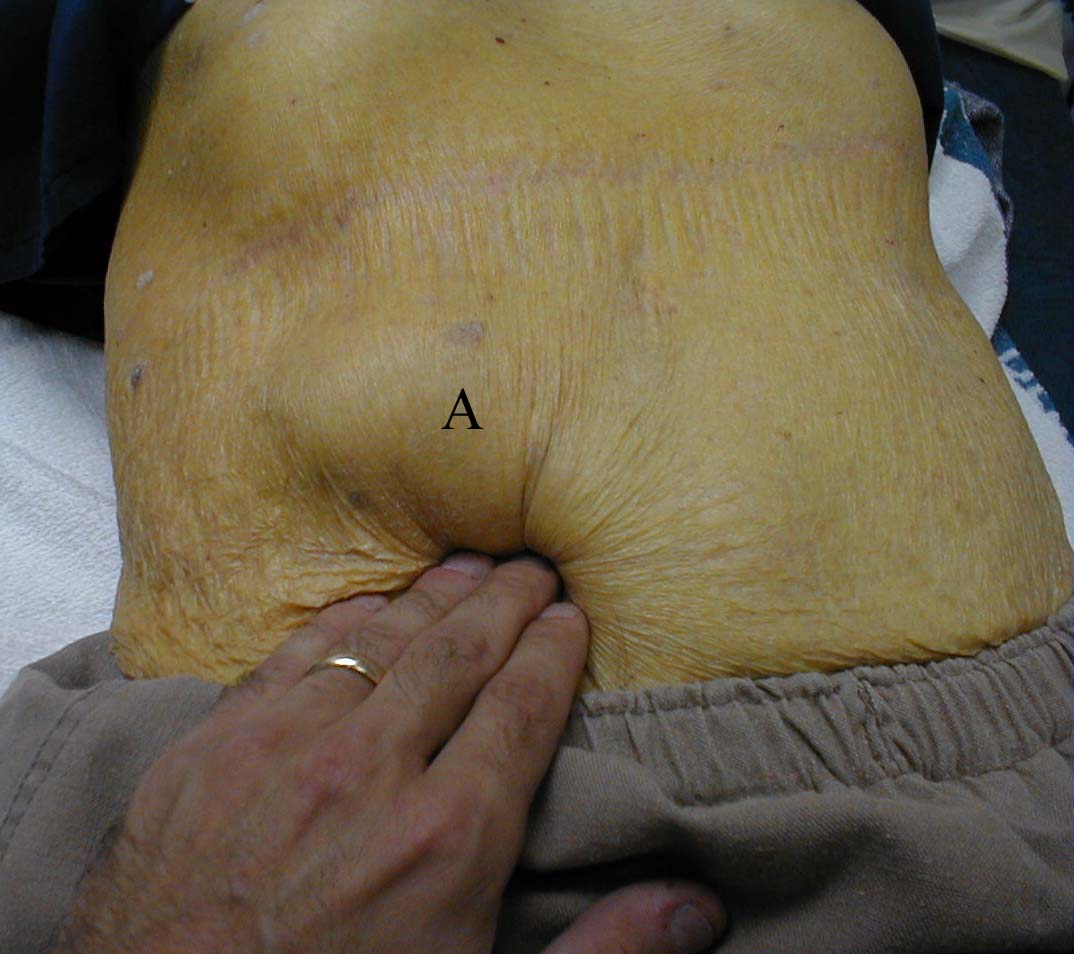 Cholangiocarcinoma has caused patient's gall bladder to become markedly dilated, and therefore, easily palpable (A). Note skin is also jaundiced due to biliary tract obstruction.
 -
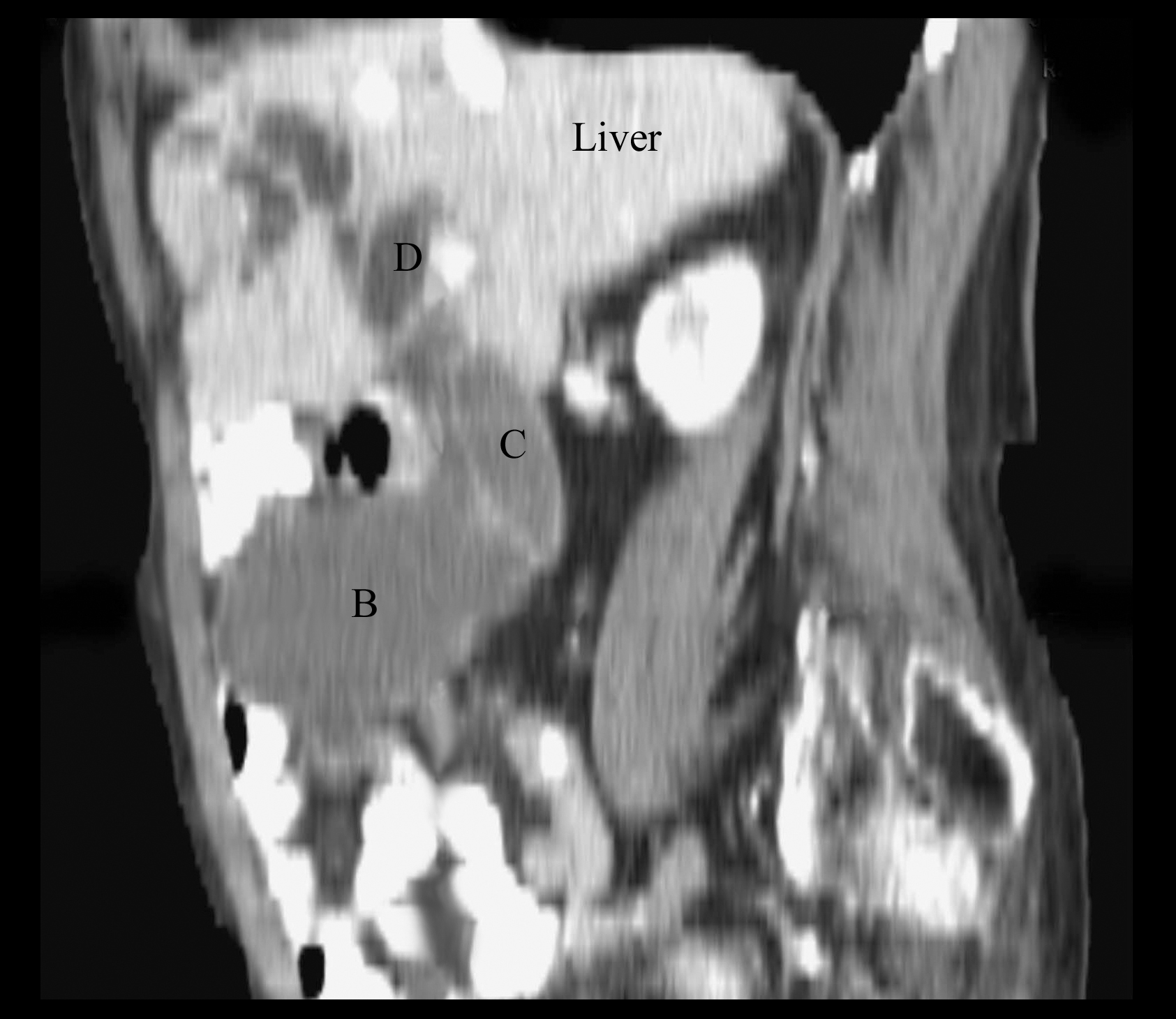 CT sagital image demonstrates dilated gall bladder (B), dilated common bile duct (C), and dilated intrahepatic ducts (D). Courvoisier described the same findings in patients with pancreatic cancer.

References
- ↑ Parmar MS (2003). "Courvoisier's law". CMAJ. 168 (7): 876–7. PMC 151998. PMID 12668550. Unknown parameter
|month=ignored (help) - ↑ Template:WhoNamedIt
See also
External links
- CancerHelp.org
- WhoNamedIt
- PMID 6822180
- Bio of Courvoisier
Template:Eponymous medical signs for digestive system and general abdominal signs