Pelvis
Template:Infobox Bone Editor-In-Chief: C. Michael Gibson, M.S., M.D. [1]
The pelvis (pl. pelvises or pelves) is the bony structure located at the base of the spine (properly known as the caudal end). It is part of the appendicular skeleton. Each os coxae (hipbone) consists of three bones: the illium, ischium, and the pubis. The illium is the largest and upper most part, the ischium is the posterior-inferior (back-lower) part, and the pubis is the anterior (front) part of the hipbone. The two hipbones are joined anteriorly at the symphysis pubis and posteriorly to the sacrum. The pelvis incorporates the socket portion of the hip joint for each leg (in bipeds) or hind leg (in quadrupeds). It forms the lower limb (or hind-limb) girdle of the skeleton.
Gender differences
- Infrapubic angle is greater than 90˚ in females and less than 90˚ in males
- Pelvic inletin males is more heart-shaped, while in females it is more round or oval
- Greater sciatic notch narrower in males
- Acetabulum in males faces more laterally, while it faces more anteriorly in females
- Sacrum more triangular in females[1]
There are four main types of pelvis
- Gynaecoid
- Normal female p elvis
- Round with enlarged transverse diameter
- Android
- Normal male pelvis
- Heart shaped
- Anthropoid
- Long anterior to posterior diameter
- Platypelloid
- Long transverse diameter
References
- ↑ Saukko P, Knight B. Knight's Forensic Pathology, 3rd Ed. Edward Arnold Ltd. 2004. ISBN 0-340-76044-3.
Additional images
-
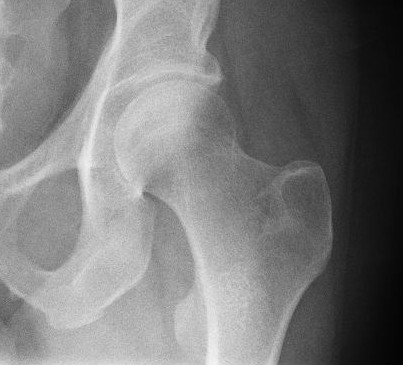
Radiograph of a healthy human hip joint
-
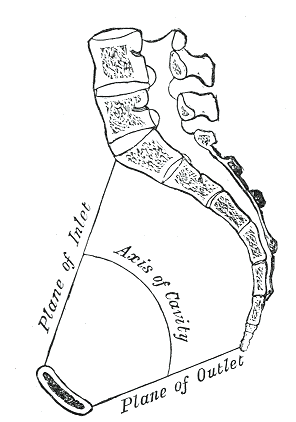
Median sagittal section of pelvis.
-
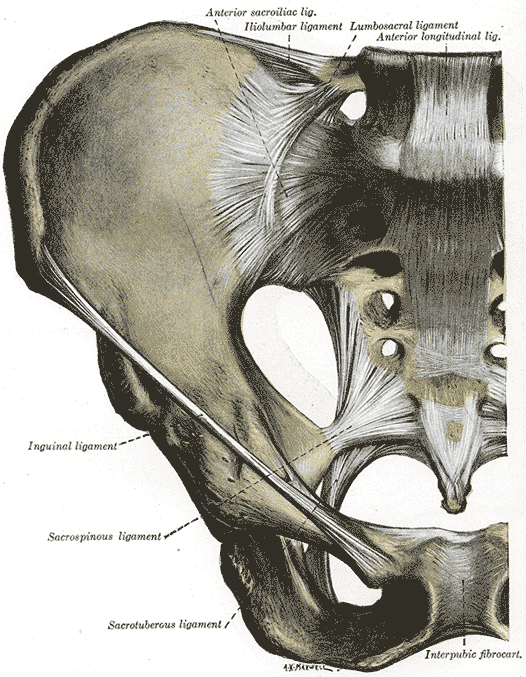
Articulations of pelvis. Anterior view.
-
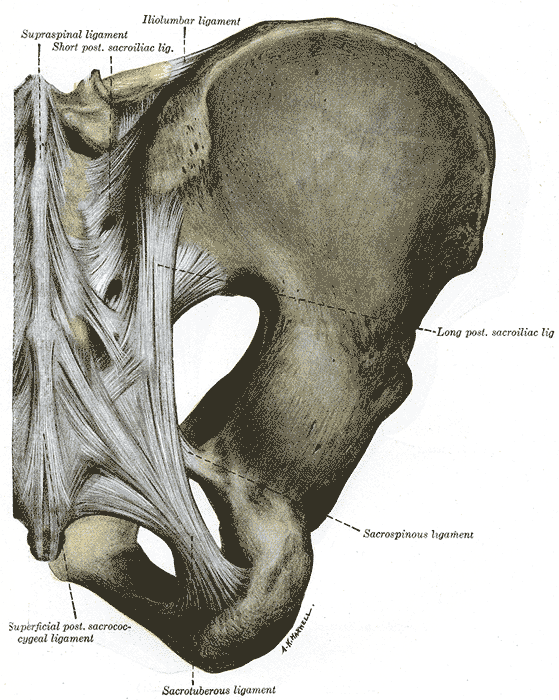
Articulations of pelvis. Posterior view.
-
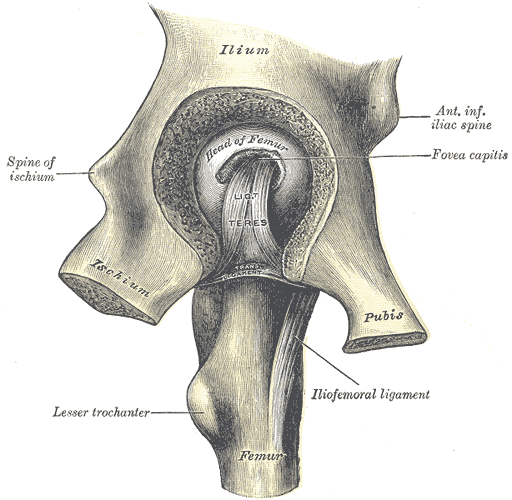
Left hip-joint, opened by removing the floor of the acetabulum from within the pelvis.


See also
- Bone terminology
- Terms for anatomical location
- Hip fracture
- Lesser pelvis
- Greater pelvis
- Pelvic cavity
- Pelvic fracture
- Pelvic Bone Width
- Coccyx (tailbone)
External links
- Template:EMedicineDictionary
- Coccyx pain, tailbone pain, coccydynia (Peer-reviewed medical chapter, available free online at eMedicine)
ca:Pelvis de:Becken (Anatomie) eu:Pelbis is:Mjaðmagrind it:Bacino (anatomia) he:אגן la:Pelvis lt:Dubuo nl:Bekken (anatomie) simple:Pelvis sk:Panva (anatómia) fi:Lantio sv:Bäcken uk:Таз tl:Balakang