Left atrium
|
WikiDoc Resources for Left atrium |
|
Articles |
|---|
|
Most recent articles on Left atrium Most cited articles on Left atrium |
|
Media |
|
Powerpoint slides on Left atrium |
|
Evidence Based Medicine |
|
Clinical Trials |
|
Ongoing Trials on Left atrium at Clinical Trials.gov Clinical Trials on Left atrium at Google
|
|
Guidelines / Policies / Govt |
|
US National Guidelines Clearinghouse on Left atrium
|
|
Books |
|
News |
|
Commentary |
|
Definitions |
|
Patient Resources / Community |
|
Patient resources on Left atrium Discussion groups on Left atrium Patient Handouts on Left atrium Directions to Hospitals Treating Left atrium Risk calculators and risk factors for Left atrium
|
|
Healthcare Provider Resources |
|
Causes & Risk Factors for Left atrium |
|
Continuing Medical Education (CME) |
|
International |
|
|
|
Business |
|
Experimental / Informatics |
Editor-In-Chief: C. Michael Gibson, M.S., M.D. [1]
The left atrium is one of the four chambers in the human heart. It receives oxygenated blood from the pulmonary veins, and pumps it into the left ventricle.
Structure
Blood is pumped through the left atrioventricular orifice, which contains the mitral valve. A normal left atrium may be up to 5.5cm in maximum diameter; any larger than this is a sign of cardiac failure. This may occur in cases of mitral regurgitation.
The left atrium of a human faces more or less posteriorly. It is named 'left' based on the chamber's embryological and (putative) evolutionary origin. The term 'base' of the heart sometimes refers to the left atrium, though 'base' is an ambiguous term.
Attached to the left atrium is the left auricular appendix (auricle). This auricle is a common site for formation of thrombi, which may embolise causing stroke or ischemic gut. Atrial fibrillation makes this more likely.
Foramen ovale
There is a foramen ovale (oval hole) between the right and left atrium in the fetus. After birth, this should close over and become the fossa ovale. If it does not, this is an atrial septal defect (hole in the heart). In the fetus, the right atrium pumps blood into the left atrium, bypassing the pulmonary circulation (which is useless in a fetus). In an adult, a septal defect would result in flow in the reverse direction - from the left atrium to the right - which will reduce cardiac output, potentially cause cardiac failure and in severe or untreated cases, death.
Blood supply
The left atrium is supplied mainly by the left circumflex coronary artery, though the branches are too small to be identified in a cadaveric human heart and are not named.
The oblique vein of the left atrium is partly responsible for venous drainage; it derives from the embryonic left superior vena cava.
Animals
Many other animals, including mammals, also have four-chambered hearts, and have a left atrium. The function in these animals is similar. Some animals (amphibians, reptiles) have a three-chambered heart, in which the blood from each atrium is mixed in the single ventricle before being pumped to the aorta. In these animals, the left atrium still serves the purpose of collecting blood from pulmonary veins.
Additional images
-
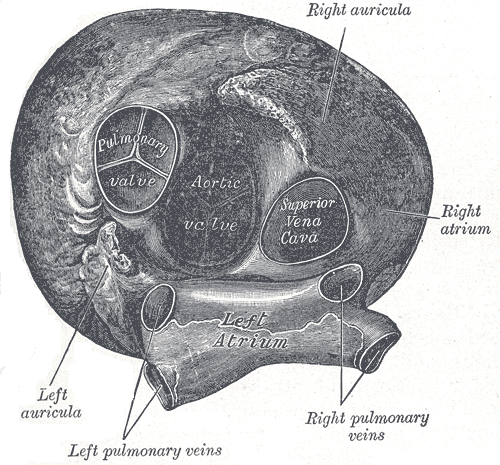
Heart seen from above.
-

Base and diaphragmatic surface of heart.


See also